
Investments
Is the portfolio creating value?
Registry and lifecycle, IFRS 9, the equity method, valuations, returns and IRR, dividends, corporate actions, look-through exposure and portfolio dashboards.
Investments →Consolidate360 takes a group from its companies' trial balances to consolidated statements, management reports and the board pack, with investments and treasury in the same place. Every figure can be explained, every change is on the record, and nobody approves their own work.
What it does
Multi-level groups, currency translation with the translation reserve, intercompany elimination, acquisitions with purchase price allocation, goodwill, non-controlling interests, and associates under the equity method. Every run proves it balances before anyone relies on it.

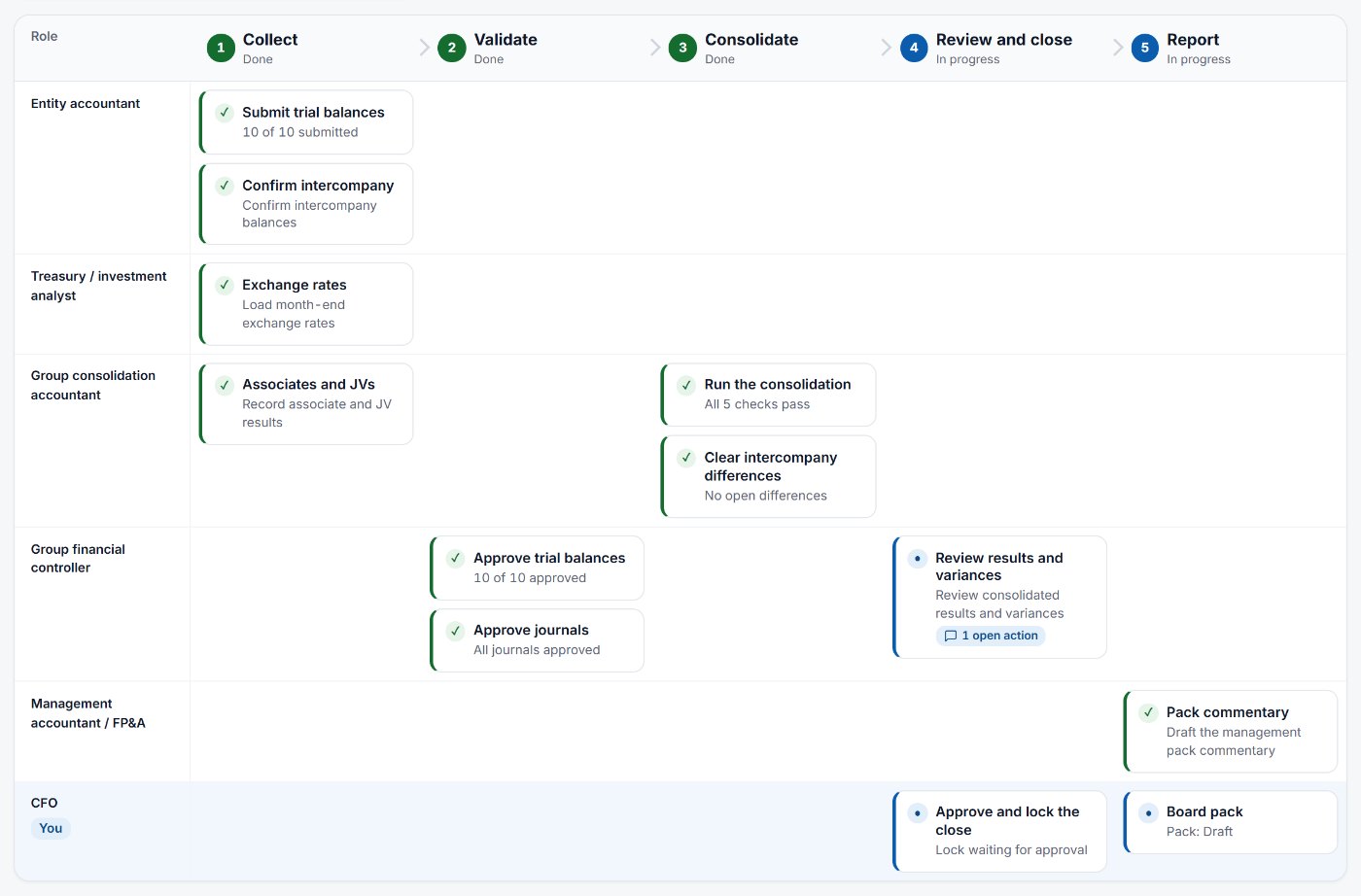
Stages from data collection to locked, tasks with owners and due dates, and gates that name what still stands in the way. The controller signs off, the CFO locks the month, and reopening needs a second approver.
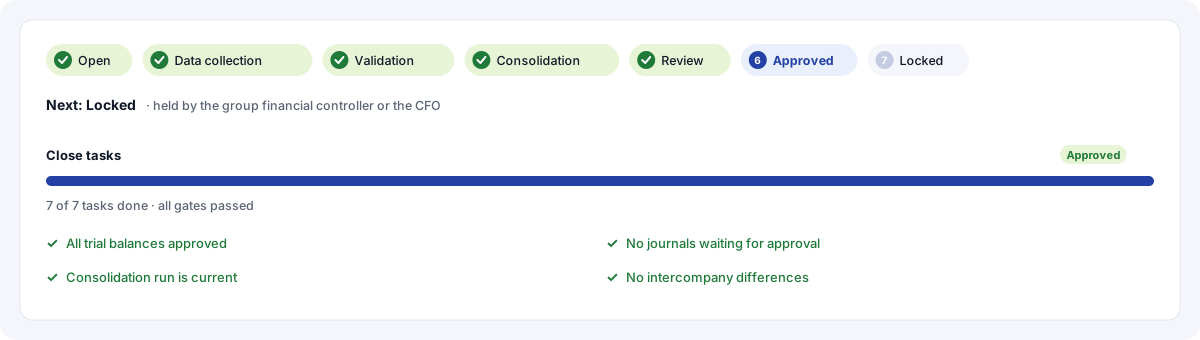
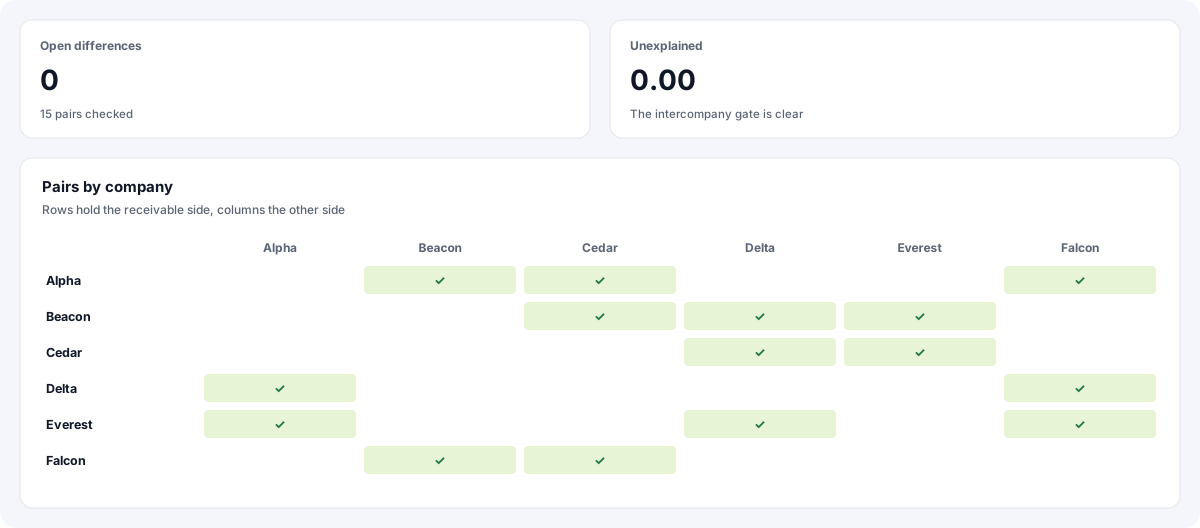
The two companies agree every pair before either trial balance is approved, compared in the currency of the transaction. A real difference needs a reason or blocks approval; a currency difference is matched and explained by the consolidation, and nothing else reaches it.
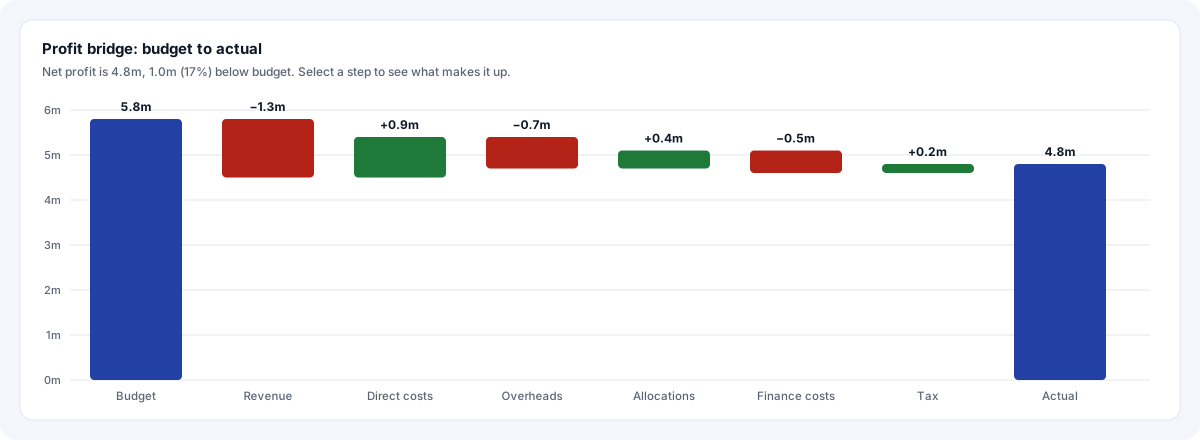
A management P&L by division and company, allocations, IFRS 8 segments and KPIs, against budget and last year. Profit bridges walk from budget to actual line by line, and every bar opens what makes it up.
Mission Control gives the CEO and CFO the month in a sentence, the treasury risks at a glance, and six questions: attention, value at risk, companies, investments, covenants and pending decisions.

Investments and treasury, included
Is the portfolio creating value?
Registry and lifecycle, IFRS 9, the equity method, valuations, returns and IRR, dividends, corporate actions, look-through exposure and portfolio dashboards.
Investments →Will we have the cash, and are we within our covenants?
Cash and liquidity forecasts with what-ifs, bank balances reconciled to the books, facilities, borrowings at amortised cost, intercompany loans, hedges, covenants tested every month, waivers, pledges, security cover and bank mandates.
Treasury →Trial balances by file layout, entry screen or API, mapped to the group chart; eleven structured input types; recurring and reversing journals.
Statements and notes in English and Arabic; taxonomies and tax rates; property, borrowings and related-party notes.
Assembled from locked numbers, with section authors, review and approval, released to the board in one version.
Report and dashboard designers: ask your own questions of the books, in chart forms that fit, pinned and shared with named people.
Comments, mentions and actions attached to the number they are about, so the explanation travels with the figure.
Select a number to see it by company, division, layer and account, and open the journals behind it.
Every screen right to left in Arabic, Arabic statutory packages, three-decimal currencies and multi-currency groups.
Corrections are new versions, reversals or cancellations with a reason. Any moment can be reproduced.
Maker-checker on every approval, approval limits, data scopes by company, a complete audit trail.
Software as a service in its own secure space for each customer, with single sign-on.
Software as a service, in its own secure space for each customer, hosted in the region.
Editions sized to your group, with investments and treasury included, and who sees them set by role.
A fixed, predictable implementation: your structure, chart of accounts and history loaded, your team trained on its own numbers.
On the EVM360 platform
Consolidate360 runs on the EVM360 platform. Planning, project delivery and the value of initiatives work on the same system and the same data.
How the platform fits together →A working session on your own entities, intercompany and investments, in English or Arabic. You keep whatever comes out of it.